
Crossing Paths

~ Intersections can reroute our destinies forever

Crossing Paths

Tag Archives: history

Is Paris burning?

10 Saturday Oct 2026

Posted by michael schinker in Immigration, ISIS, politics, Uncategorized

≈ 1 Comment

Tags

history, islam

The question was asked by Adolph Hitler in August of 1944 after ordering his military governor/general Dietrich von Choltitz to destroy the City of Lights rather than have it fall into the hands of General George Patton’s Third Army, just miles away from liberating the heart and soul of France.

Is Paris burning? Such was the title of my essay posted on November 14, 2015. Is Paris burning? I asked. I was referring to a fiery attack the previous evening outside the national stadium by three suicide bombers during an international football match. Another group of attackers simultaneously fired on crowded cafés and restaurants downtown, with one of them detonating a bomb, killing himself in the process. They weren’t done. A third group carried out a mass shooting and took hostages at a concert venue attended by 1,500 people in a historic theatre. It was Friday the 13th, an unlucky day for the 130 who perished, and the over 400 who were wounded. ISIS proudly took credit, saying that it was retaliation for French airstrikes on Islamic State targets in Syria and Iraq.

I felt that Paris, and France and Europe and indeed all of western civilization were once again in the crosshairs of madness. I saw Jihad as a disease in its early stages of metastasizing from the traditional confines of the Middle East and now headed to a town near you and me. Note that this was my observation 11 years ago.

The Ottoman Empire with Islam as the official and only religion made its bloody mark on the West from the mid-thirteenth century until World War I. The conquering Turks absorbed, adapted and modified the economics and sociologies of the lands they occupied and the cultures of the peoples they dominated. Yes, the corollary effects on literature, architecture, language and art can still be seen today from Spain to Constantinople. And yes, to some degree there was an aspect of genteel sophistication to the ways of the Sultan that may have mitigated their prejudicial brutality against Christians and Jews.

Over centuries they have never abandoned their theocratically driven objective: to erase and replace our history and Christianity with a worldwide Islamic Caliphate, one that excludes everything that we love and hold dear: our faith, our families, our freedom. Terrorist acts show the vividly true side of modern radical Islam and its agenda. What is it that we don’t understand about “Death to Infidels”?
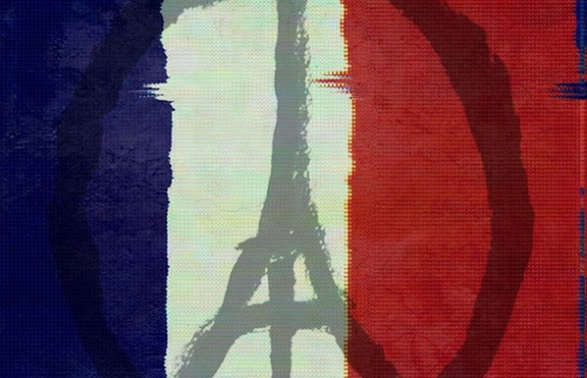
The Eiffel Tower went dark that night, maybe saving it from being an easy target for other radicals, or maybe just to show that the joie de vivre that made Paris the exciting, romantic magnet for centuries was severely wounded.

I closed my commentary with this: Perhaps we need to acknowledge our fraternité with the shocked and mourning citizens of our oldest ally, France. Maybe now more than ever we all need to recognize and say “Je suis Paris.” I am Paris.

So, almost 11 years later, where are we, mes amis?

 Just days ago, on October 7, the FBI thwarted a planned mass shooting plot targeting the Mall of America, when they arrested Sheikhdoon Abdullahi Mohamud, an 18-year-old Minnesota man who pledged allegiance, again, to ISIS and intended to murder innocent shoppers. The fanaticism continues.

Today Paris is burning. The original protests which began two weeks ago have now devolved into uncontrolled rioting. The BBC reports that it’s all driven by anger over a decades-long teacher staffing shortage, overcrowded classrooms, and neglected school buildings. Well, I don’t hear the crowd shouting “Pour de meilleures ecoles!” (For better schools). They’re waving Palestinian flags and yelling “Allahu akbar.”

What we are witnessing on the newscasts now is an example of the inarguable Biblical principle of sowing and reaping. What would a government, a society, a culture expect to grow and flourish as a result of uncontrolled immigrants flooding into your borderless country, never to assimilate but only dedicated to the destruction of your way of life?

This type of normalized civil unrest is an engraved invitation to irrational, self-driven extremists to hijack a noble idea or a movement in order to piece together a kind of Frankensteinian Monster, animated by their bloodthirsty ambition to conquer all who stand, sit or sleep in their way. They have seized a Sol Alinsky Rules for Radicals playbook premise: Never let a good crisis go to waste. This is no ordinary posters-and-marches-in-the-streets form of civil disobedience. It is a barbarian conquest.

So how do we respond to these foreshadowing events in France? It’s not like the Nazi threat of World War II, “way over there” across the Atlantic. There is no ocean that can isolate America from radical Islam, whose stated objective is to obliterate Western civilization.

If you ever took a typing class in high school, you would have practiced with the phrase “Now is the time for all good men to come to the aid of their country.” Now is the time, more so than ever, to pick up our torches and pitchforks and chase the Monster out of our village, the entire Western Hemisphere. Interpret that however you want.
Have we been misled by the Melting Pot Myth?

11 Wednesday Feb 2026

Posted by michael schinker in Immigration, labels, Uncategorized

≈ 3 Comments

Tags

history, politics, super-bowl

Watchers and non-watchers all seem to have an opinion about the Super Bowl LX halftime show. In the very center of what historically has been an evening to celebrate the apex of America’s sports culture, it was not American at all.

I’m not referring to any moral issues concerning the lead performer. With the current state of the music and entertainment industry, what else would you expect? My generation endured Prince (or The Artist Formerly Known As), and Boy George without the loss of any degree of righteous innocence. Decades before, Elvis shocked our parents with his on-stage pelvic gyrations, yet we survived.

I refer instead to the devolving condition of western Judeo-Christian society, particularly in this our almost 250-year-old republic.

CNN reported in a bold headline: “Bad Bunny’s Super Bowl halftime performance redefined what it means to be an American patriot.” Yeah, didn’t he? TIME Magazine’s website reported “Bad Bunny’s Super Bowl Halftime Show Was an Exuberant Act of Resistance.” Resistance to what exactly? An unfounded mentality of colonialization? Racist immigration policies? Xenophobia?

The event just characterized is not the topic for this post. It’s an example — a case in point — for what I believe is an accelerating effort to de-Americanize America.

“E pluribus unum” is Latin for “Out of many, one.” You must have seen it on our currency. The phrase was adopted by the Continental Congress as part of the Great Seal of the United States in 1782. It was meant to affirm the union of thirteen colonies into one nation, and was considered the de facto motto of the United States until 1956 when it was replaced by “In God We Trust.” Isn’t that an irony?

The Founders envisioned “one nation, under God, indivisible.” They saw “Give me your tired, your poor, your huddled masses yearning to breathe free” as a personal invitation to anyone from anywhere to become and enjoy what this unique political experiment outlined in the Constitution.

Citizenship was an engagement, and a responsibility, not a right, as this anonymous poem titled “A Nation of Many” describes:

Not just a paper, a stamp, or seal,
But a commitment that the heart must feel.
A tapestry woven of diverse threads,
Where freedom lives in hearts and heads. 

The key word here is “tapestry.” It’s not a patchwork crazy quilt of unmatched patterns and irregularly shaped fabric scraps. It is rather a work of hand-woven textile art, with multi-colored threads forming a dramatic expression of life. Metaphorically, it signifies interconnectedness, where individual elements, even seemingly insignificant ones, contribute to a larger, meaningful product.

Such is the thinking behind the phrase “The Melting Pot” to describe the effects of the earliest American immigration system. The concept originates from the proposition that ideally, when cultural differences meld together, they become like metals being melted down into single, stronger alloy. As foreigners came from all over the world, they brought pieces of their own culture with them. Over time, their music, food, fashion, religion, and much more, slowly became part of American culture. For example, pizza came from Italy, but it’s hard to think of anything more American than a slice of New York style pizza. Rather than embracing multiculturalism, different cultures were expected to assimilate into what would develop into a distinctive American creation.

Soon after my relatives came from Romania in the early 1900s, they packed away their native outfits into trunks and stored them away in the attic. They learned the language, even though Romanian was spoken in the home. Their children were American, not Romanian-American. They lived in a neighborhood with and worked alongside Jews, Greeks, Italians, and Eastern Europeans of all sorts. They referred to their place of origin as “The Old Country.” Get it? The OLD country. Social analysts refer to such a development as “a harmonious, hybridized society known as cultural amalgamation.” The result is a homogenous culture that functions as one, like “out of many.”

I will admit however, that there were sections of my city that became naturally segregated ethnic pockets, like Little Italy, Little Bohemia, even Dark Town.

Unrestricted immigration without the assimilation I describe will end what we know as the America of baseball, mom and apple pie without firing a single shot. 

The Super Bowl Sideshow was a carnival of Puerto Rican bravado. The music and lyrics were Spanish. It was an in-your-face celebration of Latino pride. Today, some kids in elementary school identify English as a “second language.” Some folks don’t want to blend in.

Radical Islam has not come here to benefit from “life, liberty and the pursuit of happiness.” They are here to take over. What don’t we understand about “Death to America”? It’s not just a casual slogan. It is a brazenly proclaimed, ongoing goal to caliphate the world of “infidels,”

Or, maybe we never actually achieved the “Melting Pot” goal. Maybe folks want to remain tribal, like the Pennsylvania Dutch, the Irish of Boston, the Amish colonies, China Town, even the Yankees and Confederates.

Here’s a more sinister angle: Maybe it’s a deliberate strategy of the globalist elites, using the old “Divide and Conquer” method, defined as “the practice of creating divisions between opponents to prevent them from uniting against a common foe, allowing the one who divides to gain or maintain political control.” Hmm.

No matter what direction things take going forward, it is not unrealistic to foresee that the United States, like all previous empires, will end up someday, somehow, in the dust pan of history. There is only one kingdom that endures forever, the Kingdom of Heaven, with a citizenry of all who claim Jesus Christ as Lord and Savior.

“Then the seventh angel sounded: And there were loud voices in heaven, saying, ‘The kingdoms of this world have become the kingdom of our Lord and of His Christ, and He shall reign forever and ever!’” (Rev. 11:15) The question to consider is – whether you have melted into the pot or not, regardless of your ethnicity, race, color, heritage, politics, or status – will you be there?

More thoughts about JFK

04 Wednesday Jun 2025

Posted by michael schinker in John F. Kennedy, Uncategorized

≈ Leave a comment

Tags

history, jfk, jfk-assassination, politics

Recently I was asked to write a memoir about where I was when I heard about the assassination of President Kennedy and how it affected me. So, here goes:

I was a senior at Creighton Prep High School, in the middle of art class. It was a Friday, just after lunch period. An announcement came over the speaker system informing us that the President had been shot during a motorcade through Dallas, Texas, and was rushed to a hospital. We were led in prayers for what suddenly became a shockingly serious situation for Kennedy and the country. Efforts to save him were futile. He was declared dead at 1:00pm Central Time.

A schoolmate’s father died of a heart attack on the same day. Two sad funerals occurred then on Monday. Many tears were shed.

Our family had a more than President-citizen relationship with JFK. My Aunt Helen, my mom’s sister, was a major player for the Democrat Party of Nebraska’s effort to promote Kennedy’s campaign for the presidency in 1960. Amazingly, for her efforts she was appointed personal secretary to Robert Kennedy when he became Attorney General in January of 1961, a post she held until he resigned the office to run for the U.S. Senate from New York.

On the evening of November 20, 1963 Helen had actually spoken with the President at an exclusive party celebrating the 38th birthday of brother Robert. The following morning, John and Jackie left for Texas.

From the minute CBS News anchor Walter Cronkite battled to hold his emotions in check to inform the world of JFK’s death, through a weekend of non-stop live black and white TV broadcast updates until the interment, life was on hold. We were eating Sunday breakfast in the living room when we watched someone later identified as Jack Ruby shoot Kennedy’s alleged assassin Lee Harvey Oswald on live TV. I almost choaked on my scrambled eggs.

My Uncle John, Helen’s and my mother’s brother, who at the time was living in Falls Church, Virginia, and working for the CIA, somehow against a crushing crowd of onlookers, made it into Arlington Cemetery. The funeral procession was long and thousands had gathered along the route across the Potomac to catch a glimpse of it. John, a decorated veteran of World War II himself, saw several news photographers standing on tombstones to film the event. After chasing them away, disgusted, he went back home, missing the historic horse-drawn caisson headed to the gravesite.

I never met the man. I was at home babysitting my toddler brother when the family went to the social gathering in June of ’59. Even so, after his death I gradually became more impressed, more affected, by his charm, eloquence, charisma and youthful energy, all qualities usually foreign to a resident of the White House; by the storybook Crusader-Knight mystique of a dynamic leader fearless in his vision for social justice and the race into space; with his communication skills, and ability to inspire a nation with his “Ask not” challenge to patriotism and national pride. In many ways, he modeled the title of his bestselling book, Profiles In Courage. That final day in Dallas hurt me enough to write from my heart a poem 52 years later, to lament the loss of so much more than a president: The loss of my generation’s Camelot.

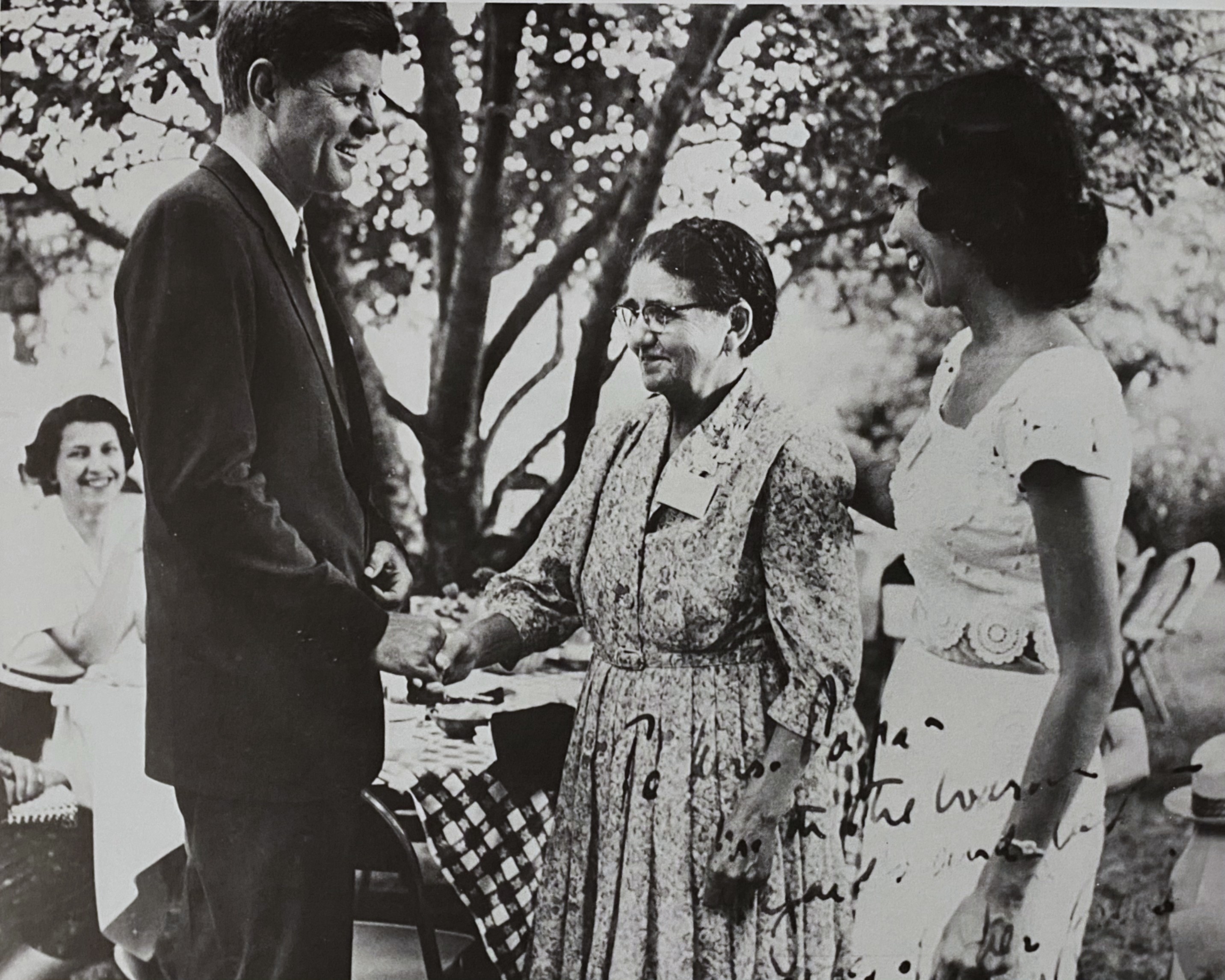
PS. My grandmother pictured here with Kennedy also shows my mom, far left and Helen introducing the then Senator from Massachusetts prior to his declaring his presidential candidacy. The original 8 x 10 was personalized with the following: “To Mrs. Popa – with the warm regards and best wishes of her friend. John Kennedy.” She is featured in my “Immigration, 1914” post, October 19, 2024. Maybe I will write a story titled “Romanian Peasant Meets President-to-Be.”

11/22/63 Revisited

27 Thursday Mar 2025

Posted by michael schinker in assassination, John F. Kennedy, Uncategorized

≈ Leave a comment

Tags

books, history, jfk, jfk-assassination, politics

Recently, thousands of documents relating to the JFK assassination have begun to be made public. Whether the truth about what really happened that day may be found or not, the Kennedy years are a moment in time that older folks like me will not forget. That considered, I thought now would be a good time to revisit my thoughts from a post on Nov. 22, 2015.

Seems as though most of my memories of John F. Kennedy are archived in black and white:

The TV campaign debates with a sweaty Dick Nixon, who looked like a stiff cardboard prop in the shadow of the bigger than LIFE magazine war hero bred for achievement by Massachusetts’ premier political family.

The bright but bitterly cold inaugural on the steps of the Capitol, frozen under a Nor’easter snowstorm’s fresh blanket of dazzling white, a distinctive backdrop for a fledgling president’s epic “And so, my fellow Americans, ask not” speech, challenging us in a valiant call to arms against tyranny, poverty, disease and even war itself.

The televised series of White House tours graciously hosted by a sophisticated, shyly soft-spoken Jackie who assured us that it was just as much “our house.” The candid photos of handsome toddler John John playing hide-and-seek under the desk of the most powerful man on earth.

The who’s-going-to-flinch-first live TV broadcast to an on-the-edge-of-our-seats audience by a stern and deadly serious JFK demanding that a raging Russian remove his nuclear missiles from Cuba – or else. We held our national breath, praying, all eyes fixed on the doomsday clock.

And then came that day in Dallas.

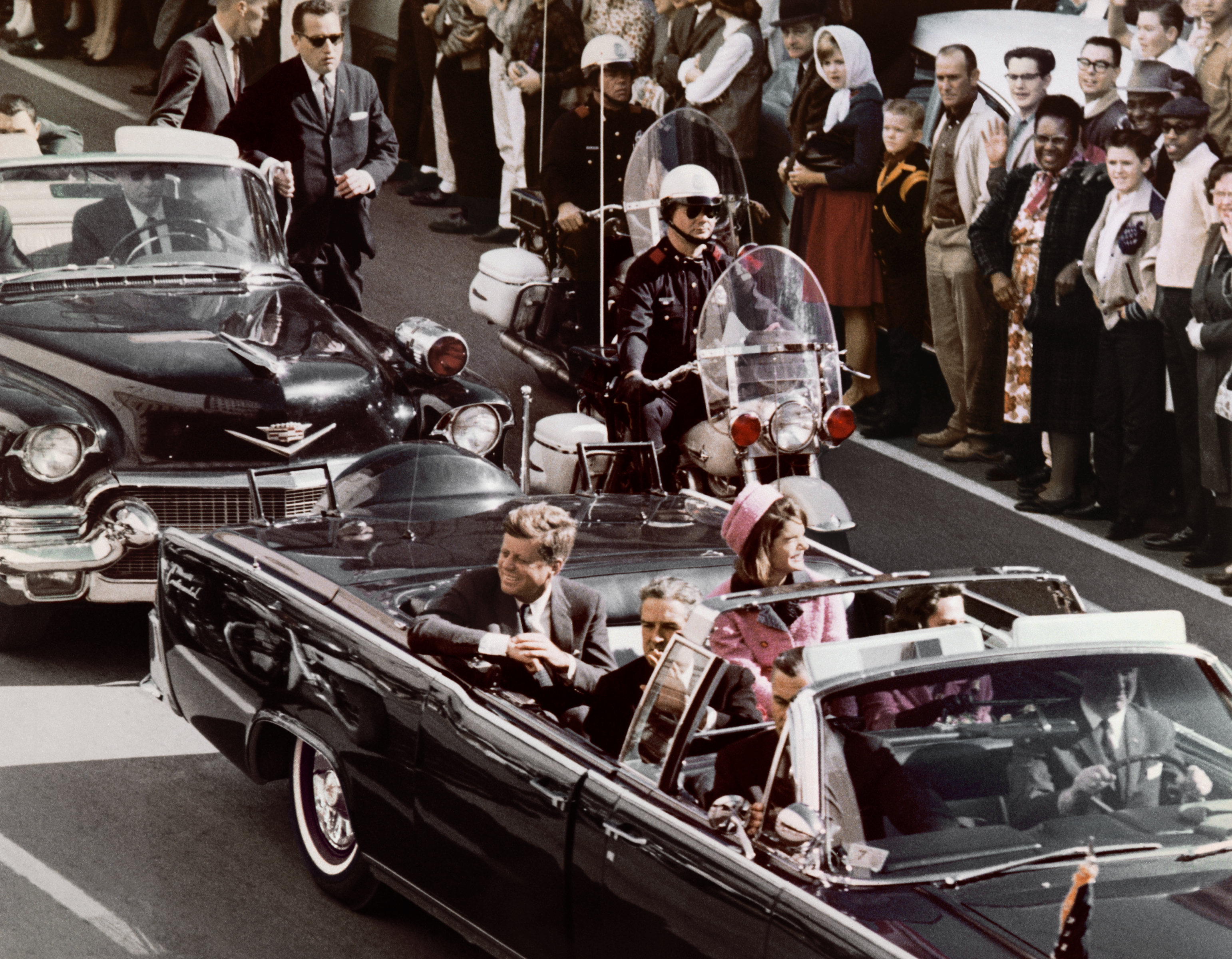
It started out with smiles and waves – and color. Like heaven’s giant spotlight, suspended in a flawless azure big-as-Texas sky, a beaming golden noontime sun illuminates a cheering crowd at Love Field, all reaching out for a once in a lifetime touch from the chief executive’s hand. The First Lady, wearing that now iconic strawberry pink and navy trim Chanel wool suit and matching hat, cradles so tenderly an ill-fated bouquet of red roses, too soon abandoned on a blood-spattered seat of the presidential Lincoln Continental where the life of Camelot’s king was lost and everything suddenly faded back to black and white again.

For a very long time.

An Ugly Remembrance: Auschwitz

27 Monday Jan 2025

Posted by michael schinker in Auschwitz, Holocaust, suffering, Uncategorized, war

≈ 1 Comment

Tags

Auschwitz, history, Holocaust, poland, travel

Today marks the 80th anniversary of the liberation by Soviet soldiers of Auschwitz, the German extermination camp in Nazi-occupied Poland. More than 1.1 million European Jews died there in gas chambers or crematoria behind the walls and barbed wire hiding horror and suffering beyond description.

Looking back over six or seven thousand years of our blood-spattered world history, the “Final Solution,” as the Nazis euphemistically referred to the extermination of Jews, gypsies, the disabled, criminals, homosexuals and others deemed unworthy persons, must rank among the top five on the list of brutalities committed against innocent human beings.

The imprisonment process took away everything from a person, no matter what age. They lost gold teeth, shoes, clothing, their dignity, even their names — substituted by tattooed numbers. I’m guessing many lost all hope and even a glimmer of what was left of their faith. Then, they lost their lives.

Recently I saw a post of the railroad tracks going into the gate at Auschwitz with this text over the photo: “If there is a God, he will have to beg for my forgiveness.” It had been carved on a wall inside a building there in the camp.

Today I plan to pause, alone, and listen to a powerfully moving work by composer Henryk Górecki titled “Symphony of Three Sorrowful Songs.” The setting of the first is a Fifteenth-Century lament from the Monastery of the Holy Cross in Romania, and the third replicates a mournful folk song in the dialect of a region in southwest Poland. The source of the second movement’s text, sung so woefully by soprano Joanna Koslowska, is a prayer written on the wall of a Gestapo cell in Zakopane, Poland, by an 18-year-old girl imprisoned there. The town’s name means “buried.”

In an interview Górecki spoke about the horrific events of the war and commented that “Those things are too immense; you cannot write music about them.” I agree with his sentiment, but must argue that his composition has indeed sadly accomplished what he denies is possible.

Thanks to his sorrowful music, I will never forget, even if, in a vain effort to erase the images of unspeakable brutality, I want to.

Enter your email address to follow this blog and receive notifications of new posts by email.

Follow Crossing Paths on WordPress.com

Posts

  • Is Paris burning?
  • America, do you have memory loss issues?
  • Lest we forget . . .
  • A Tale of Two Gardens
  • Have we been misled by the Melting Pot Myth?
  • Just another Christmas?
  • Memento mori, Episode 5
  • Have you ever lost your car in a parking lot?
  • Apparently, we have put down the WELCOME mat for our worst fears
  • Memento mori, Episode 4
  • Memento mori, Episode 3
  • Memento mori, Episode 2
  • Memento mori. Episode 1
  • It’s the end of the world! Maybe.
  • More thoughts about JFK
  • Happy Mother’s Day
  • Jelly Beans
  • 11/22/63 Revisited
  • An Ugly Remembrance: Auschwitz
  • “O Come, O Come Emmanuel
  • All About Eve
  • Immigration, 1914
  • It’s that time of year again
  • Gone forever: The world of Norman Rockwell.
  • Are you a man, or a mouse?
  • God Bless America? Why?
  • Zinnias
  • “It’s a bittersweet symphony, that’s life.”
  • Remembering Emma Rose
  • April, stand up and take a bow!
  • Unknown's avatar
  • Unknown's avatar
  • devotedlytastemaker6724d28621's avatar
  • sublimefuturistically42cce579d5's avatar
  • Unknown's avatar
  • CJ's avatar
  • mitchteemley's avatar
  • Unknown's avatar
  • Unknown's avatar
  • Unknown's avatar

Enter your email address to subscribe to this blog and receive notifications of new posts by email.

Join 79 other subscribers

Blog at WordPress.com.

  • Subscribe Subscribed
    Crossing Paths
    Join 79 other subscribers

    Have a WordPress.com account? Log in now.

  • Crossing Paths
    View site in Reader
    Manage subscriptionsSign upLog in
    Report this content
    Collapse this bar
Loading Comments...