
Our family was fortunate to have recorded several sessions of oral history with my maternal grandmother, Maria Ocneriu Popa, before she passed in 1979 at age 88. Her recollections were vivid and remarkably detailed, all the way back to her early childhood. I would like to share her memories of coming to America as a 22-year-old from Cristian, a quiet village in Romania.
In 1914, almost 1.2 million foreign-born people entered the United States. Two of them were Maria and her father, Vasile. They left home in the dark on a Sunday in mid-March, taking a train to Hamburg, Germany. Our research with immigration records indicated they boarded the Hamburg-American Line’s S.S. President Lincoln. “We traveled third-class. I was seasick most of the trip,” she said. They reached New York harbor on April 3, after 15 days at sea. “My father, who was not in good health, was singled out by the doctors who noted his condition with a chalk mark on the back of his coat. This meant he might be returned to Romania.”
Maria and Vasile were detained at Ellis Island for “two or three weeks until the authorities received word from our relatives in Omaha that they would be responsible for us.” Finally reaching their destination, they stayed with Maria’s sister in an apartment in South Omaha. “I wasn’t interested in much of anything during those first few days, she lamented. “If I had the money, I would have returned to Romania. And if the health authorities had deported my father, I surely would have gone back home with him.”
What was Omaha, Nebraska, like back then? Poet Carl Sandburg was succinct in his 1915 depiction:
Omaha, the roughneck,
feeds armies, eats and
swears from a dirty face.
Omaha works to get the world
a breakfast.
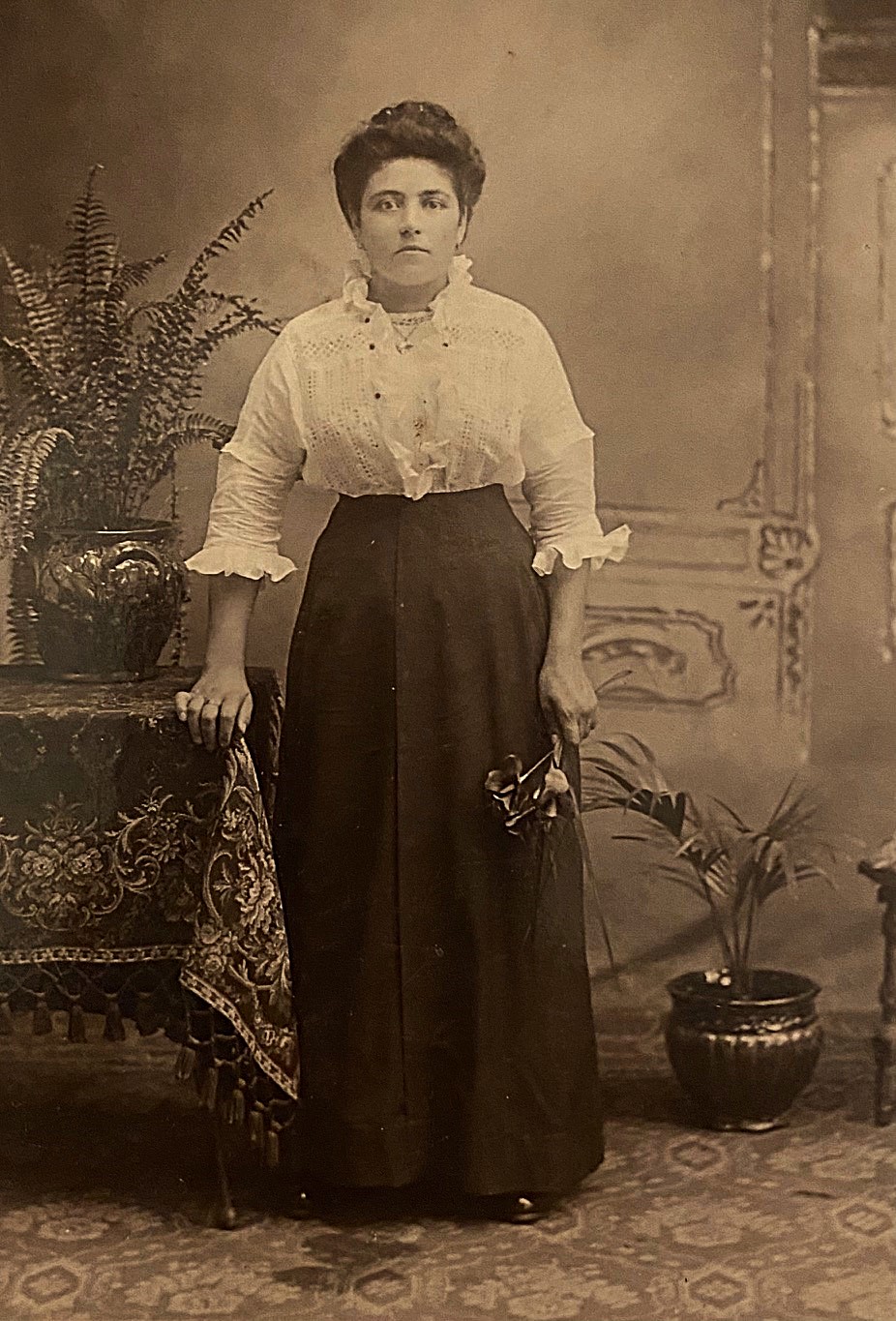
“I was able to find a job right away, working for Armour’s,” she remembers, “cutting big pieces of meat into little pieces for seven cents an hour.” During the early 1900s, Omaha was on the way to becoming the livestock and grain marketing center of the Midwest. Armour, along with other slaughterhouses like Swift and Cudahy, capitalized on an unskilled and inexperienced immigrant labor force willing to work for pennies a day.
Eventually, “by making friends and going to the Romanian dances on Sunday nights, I was able to get over my homesickness,” Maria said. Among the several Romanian suitors calling on her was Nicolae Popa, who arrived in New York in 1906. She did not recall the names of all the young men who proposed marriage, but Nicolae became Maria’s first and only choice. “When I went shopping for my wedding dress, my father and sister went with me,” Maria recalled. “The price was $10.00 for the dress. The veil was extra.”
When Maria was on the train to Hamburg, a woman from the nearby village of Apoldu de Jos boarded and sat next to her. “She asked where were we going and why was I crying. When I told her ‘to America,’ she said ‘Maybe you will meet a young man from my village there.’” She did.
Maria traveled almost five thousand miles to meet and marry a man who had concurrently grown up in a village within walking distance of her own. Often it seems, we have a plan for our lives, only to discover that God’s plan is different than ours. His thoughts for us are often much bigger than we realize, and His ways take us on paths we could never have imagined. And I rejoice that it is so.
You can add this to your My How Things Have Changed folder.
 Crossing Paths