
• About

Crossing Paths

~ Intersections can reroute our destinies forever

Crossing Paths

Category Archives: Life and death

Memento mori, Episode 5

23 Tuesday Dec 2025

Posted by michael schinker in Life and death, religion, suffering, Uncategorized

≈ 2 Comments

Tags

death, life, memento-mori

This is the final installment of my “Memento mori” (Remember you will die) series of real-life scenarios to remind us of the brevity of our lives, and to be prepared for its inevitable, often seemingly premature, end. More details about my perspective and intentions can be found when you scroll back to the August 26th, 2025 initial post. This last one is personal.

Last week we buried my brother. My one and only brother. My only sibling.

It was unexpected. He entered Methodist Hospital on the Tuesday before Thanksgiving for a battery of tests to identify why he had been experiencing some unusual symptoms his Primary couldn’t diagnose. By Friday he was in the ICU on a respirator. Early Saturday morning, with his immediate family present by his bedside, he died. He was barely 68.

When many of our family and friends heard the news, the common response was “What!” The shock, the disbelief went on for days as grief took over in the empty spots of the lives and hearts of those who knew him. How could this happen?

At the wake, his widow and two adult children testified to his many virtues as a husband and a dad, describing a man of character and compassion, consistently serving others.

I had the last words that evening, looking out on a crowded room of somber faced mourners, longing for some semblance of comfort. I prayed ahead of time that I could get through my eulogy without choaking up. With one trembling hand holding the pages and the other gripping the side of the podium, my voice broke the heavy aura of sadness.

I said, “I don’t want to be here, doing this. It just doesn’t seem fair.”

After talking about how well he lived and lamenting his sudden passing, I asked “But what does God have to say about such a thing, the unexpected tragedy, the terminal cancer diagnosis, the fatal accident, the death too soon?” I quoted several Bible verses that address this issue of man’s frailty and his inevitable end, including James 4:14, which states quite bluntly “. . . our life is just a vapor that appears for a little while and then vanishes away.” My brother’s life vanished away, leaving not even the trace of a shadow.

Is there a lesson here, I asked? If there is, it’s this: We should never assume that someone we love, or care about, will be here tomorrow. Life is so fragile, life is fleeting.

In closing, I ended with this recollection: When a young 46-year-old John F. Kennedy passed — a tragic death too soon – this lyric from an old Irish ballad was quoted and later a book written titled: Johnny, we hardly knew ye. In other words, even at age 46, it wasn’t enough. Not enough days. Not enough minutes.

And then I spoke directly to my brother. “Nick, we didn’t have enough time with you. You slipped away too quickly. The sand in your life’s hourglass rushed through to the bottom and we couldn’t see it until the final grain fell with a terrible thud, like a boulder. So we’ll have to make up for it — in heaven.” Then I sat down, weeping.

Dear reader, will you learn from my admonitions, about the end of your days? How will you deal with this statement from Ecclesiastes, where the wise Preacher says, “The same destiny ultimately awaits everyone, whether righteous or wicked, good or bad . . .  religious or irreligious.”

The post-mortem is not the end. The grave is not the end. The afterlife is exactly that. But until then, today, will you Memento mori?

Memento mori, Episode 4

25 Saturday Oct 2025

Posted by michael schinker in Life and death, religion, Uncategorized

≈ 1 Comment

This is the fourth installment of my “Remember you will die” series of real-life scenarios to remind us of the brevity of our lives, and to be prepared for its inevitable, often seemingly premature, end. More details about my perspective and intentions can be found on the August 26th post.

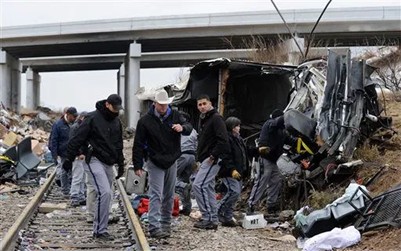
Besides the unusual circumstances of the event, what makes this tragedy unique is the victim’s mother’s response. It is a sad story, nonetheless, about how unexpected circumstances like weather and a train can in an instant alter the lives of so many people.

NEWS ITEM: It was on the night of January 14, 2015, when a prison transport vehicle carrying 15 men skidded off a Texas highway overpass and plunged into the path of a moving Union Pacific freight train. After the collision, the bus was dragged for about 200 yards along the tracks, leaving it a crumpled mass alongside the tracks before coming to a stop near Penwell, just west of Odessa. The prisoners did not have seat belts and were handcuffed together in pairs, officials said. Some of them were ejected from the bus after it struck the train.

Two long-time veteran prison department officers and eight inmates died from injuries suffered in the accident. “It’s as bad as you can imagine,” Odessa Fire and Rescue Battalion Chief Kavin Tinney remarked. “In 32 years, it’s as bad as anything I’ve seen.” Officials later concluded that icy roads were to blame for the crash.

One of the victims, 29-year-old inmate Tyler Townsend had called his mother in Benbrook the night before. “I said, ‘Let’s pray for a safe journey. Call me Sunday night,’” Petra Townsend recalled when interviewed. “He said, ‘OK.’”  “I said, ‘I love you.’ He told me he loved me too, and that was it.”

She admitted that her son chose his own journey outside of the law early on, using drugs as a teenager. He went to prison twice before, for drugs and other crimes, including car theft, but managed to graduate from an alternative school, and even tried college. “I always believed he was going to change that path,” his mother told reporters. She felt that Tyler believed it, too. Sentenced to three years, Tyler had been denied an early release on Dec. 28, just a couple weeks before the accident.

A deeply religious woman, Mrs. Townsend said her son had recently been baptized in prison. She said her faith does not have room for laying blame for her son’s death. “That’s part of a plan we can’t understand. This is God’s business. This is God,” she repeated. “No, no, no. Don’t question.”

I am fairly certain that none of the men involved in this tragedy woke up that morning and expected to end up later that day in a morgue. Talk about bad timing – the weather, an icy overpass, the train schedule. But when it comes to death, what would be good timing? 

“The same destiny ultimately awaits everyone, whether righteous or wicked, good or bad” (Eccl. 9:2).

Memento mori, Episode 2

03 Wednesday Sep 2025

Posted by michael schinker in Bible, Life and death, religion, Uncategorized

≈ 1 Comment

Tags

Bible, faith

If you are new to this site, before reading the following I suggest you go back to the August 26th post which will explain in detail what my intentions are with this Episode 2.

Basically, I am presenting a series of real-life scenarios to remind us of the brevity of our lives, and to be prepared for its inevitable, often seemingly premature, end. We can go all the way back to Genesis 3:19 for the origin of another “memento” phrase, one used by the Roman Church traditionally on Ash Wednesdays: “Memento, homo, quia pulvis es, et in pulverem reverteris.” (“Remember, man, that thou art dust, and unto dust thou shalt return.”)

This tragic event occurred in 2011 but remains an incident appropriate for this series.

NEWS ITEM: It’s a typical, hot early July evening in Arlington, Texas, home of the Texas Rangers ball club. Shannon Stone had driven 150 miles to the ballpark to enjoy the game that night with his young son, Cooper, sitting right next to him in the left field stands. It’s the ultimate father-son American experience — until he dies trying to catch a ball. It’s hard to comprehend.

The fateful accident happened in the second inning after Oakland’s Connor Jackson hit a foul ball that bounced back onto the field.

Rangers’ All-Star outfielder Josh Hamilton, ironically Cooper’s favorite player, snagged that ball and tossed it into the stands, aiming right for Stone and his boy.

Stone leaned over the railing to retrieve Hamilton’s throw, probably the first time he had an opportunity to catch an MLB ball for his son. He must have been aware of this surely magical moment, a memory he hoped his son would cherish forever. Then he apparently lost his balance, and tumbled over as Cooper and hundreds of fans watched in horror on the Jumbotron screen, falling head-first about 20 feet to the concrete below. Stone went into cardiac arrest while being transported to the hospital and died in transit.

Stone was just 39-years old, an 18-year veteran lieutenant with his hometown Brownwood, Texas fire department, and undoubtedly had experienced his share of dangerous situations, risking his life for the sake of others.

Still conscious on a stretcher leaving the park, Stone pleaded, “Please check on my son. My son is up there all by himself.” The EMTs who carried him out reassured him. “Sir, we’ll get your son. We’ll make sure he’s OK.”

 I’m not sure that he ever will be.

Post script: The Rangers went on to beat Oakland 6-0.

All About Eve

23 Saturday Nov 2024

Posted by michael schinker in Bible, Life and death, religion

≈ Leave a comment

I don’t mean the 1950 film starring Bette Davis at perhaps her most barbed wire personality worst. I am referring to the Bible’s first woman and genuine femme fatale.

What if Eve had stood alone in front of that special tree, without The Tempter? Would she have succumbed to the magnet of mystery, biting off more than she could chew, the juice of disobedience running down her chin, the inside of her head exploding with knowledge and her soul shrinking into a heart of darkness? I say No. She needed prodding, to hear the hissing lure of doubt in her ears.

What if I had stood alone, facing that tree?

“It’s a bittersweet symphony, that’s life.”

28 Sunday Jul 2024

Posted by michael schinker in Life and death, Live your purpose, perceptions

≈ 1 Comment

Tags

life, music

Ever hear a song but not really listen to it? The melody is great but the words just fade into the background. I had that revelation the other day, listening through my earbuds to a selection of my Likes on Spotify while on the treadmill at the gym. I had “heard” the song before, but this time the words really spoke to me.

It’s a tune by a group known as The Verve, a British indie pop scene band that emerged into popularity in the late ‘90s, and the song was “Bittersweet Symphony.” Over time, it has been “covered” by several bands, including a rather haunting instrumental version by a musician known as Mind Base.

Obviously, the artist is expressing a deeply personal philosophical opinion on how he sees the human experience. Life is bitter. Life is sweet, and I might add, usually not in equal proportions. If you’ve been around a while, maybe you have come to a similar conclusion. Or perhaps the pendulum has swung too far into bitter darkness, as with Macbeth, who laments in Act 5, Scene 5:

Life’s but a walking shadow, a poor player
That struts and frets his hour upon the stage
And then is heard no more: it is a tale
Told by an idiot, full of sound and fury,
Signifying nothing.

Maybe you characterize your own situation more like a journey, with a series of ups and downs.  Or it’s an hour glass, with the sands of time rushing through the funnel until the last grain falls onto the pile at the bottom. However we see it, unless we have purpose, we may conclude with author Kurt Vonnegut, who, paraphrasing wise Solomon, wrote “Eat, drink and be merry for tomorrow we die.”

Another lyric that I found poignant in The Verve’s song was when he confesses

Well, I’ve never prayed but tonight I’m on my knees, yeah
I need to hear some sounds that recognize the pain in me, yeah
I let the melody shine, let it cleanse my mind, I feel free now

I don’t think that Macbeth ever fell to his knees in prayer, but that can be for anyone the place to start, to find purpose, to achieve balance in the symphony of your life, to harmonize the beauty of each instrument played, to read the unique notes written for your personal composition. Most importantly, though, make sure you follow the right conductor. Actually there’s only One.

Milestones

20 Sunday Dec 2020

Posted by michael schinker in Christmas, December, Jesus Christ, Life and death

≈ 2 Comments

“In a minute there is time
For decisions and revisions which a minute will reverse.

For I have known them all already, known them all:
Have known the evenings, mornings, afternoons,
I have measured out my life with coffee spoons.”

— T.S. Elliott

* * *

One definition listed for “milestone” is “an action or event marking a significant change or stage in development.” It seems that as humans we like to do that, to mark our passage through life, our achievements, to measure our progress. Today is my 75th birthday, a definite historical milestone for me.

It’s interesting how we quantify time in our lives. Young children boast about their age counting by single specific years. “I’m five, but I’m gunna be six,” or seven or eight. Later it’s a bit more reluctant and less specific, by the decade: in my twenties, thirties, forty-ish. At this juncture I can gauge my lifespan by quarter-century marks, three of them! Yikes. That’s a lot of water under the bridge as they say, some of it a peaceful meandering stream, and at other times a raging torrent.

The Bible’s Book of James says, “What is your life? You are a mist that appears for a little while and then vanishes.” James is probably testifying to Psalm 144:4 which says, “Man is like a breath; his days are like a passing shadow.” But as we all know, some folk’s shadows disappear more quickly than others. Just a while back the local 10 o’clock news reported on the tragic death of a nine-year-old boy struck by a car and killed on his way home from school. Changing to a more upbeat tone, the news anchor’s next item to report was the celebration of a great-grandmother’s 102nd birthday. What a perplexing paradox. On the eve of my birthday five years ago I lost a dear friend to an accidental death. He was just 26, an Army vet who had served without a scratch in Afghanistan. I was hoping to have years of buddy time together, but sadly it was not to be. Last year right before Thanksgiving a young man I was just starting to get to know better without warning took his own life. It’s this cruel disparity in the days of our lives that makes me scratch my spiritual head and wonder, Hey, what’s this all about anyway? How does God decide when to click the stopwatch on and off?

Although we like to think otherwise, much of what happens in the universe remains a mystery, the answers known only to God. I do believe, however, He gives us enough information and guidance to live out our allotted time on this planet as well as we can. “So teach us to number our days that we may get a heart of wisdom,” prays the writer of Psalm 90, traditionally attributed to Moses, who himself lived to be 120. It is wise, then, to be aware of our ever impending mortality.

In thinking about writing this post, I remembered the lines quoted above in the intro from T.S. Elliot’s The Love Song of J. Alfred Prufrock, the poem’s subject lamenting that his life basically amounts to nothing other than the droll repetition of one uneventful, insignificant day after another. As with any piece of art or literature, there are critics and a variety of interpretations. One such commentator on the poem writes, “The image of the coffee spoon is one of middle-class domesticity. The idea of measuring one’s life with such an instrument implies a lack of risk or excitement; instead of big decisions or milestone events defining the course of his life, all Prufrock has with which to mark his time on earth is the quotidian coffee spoon.” That, my friends, is a real tragedy. A purposeless, unfulfilled, empty life isn’t life at all, but a painfully prolonged expectation of one’s ultimate termination in the grave, when time mercifully runs out.

In a complete contrast, the Bible is full of advice on profitable time management, just one of the keys to a life worth living. “Look carefully then how you walk, not as unwise but as wise, making the best use of the time, because the days are evil” (Ephesians 5:15-16). How relevant is that age-old advice today! [Go to https://www.openbible.info/topics/time_management for many more examples.]

Life can be anything but mundane. Shouldn’t we then treasure every minute we have, to vigorously live out the destiny God so graciously offers us, to leave a legacy of faith and love behind to our family, friends and neighbors? Even at this late stage of my life I want to “get a heart of wisdom,” and to learn how to properly “number our days.” Personally, with that perspective put into practice, I’m hoping for more than a measure of coffee spoons to be recorded on my tombstone. What about you?

Will you make this Christmas season the most important milestone in your life with a decision to believe that God sent His Son Jesus Christ to save us all from a purposeless life and to give you eternal hope? Don’t let this moment of opportunity pass. Follow the spiritual star of divine inspiration leading to your personal encounter with the Savior. Sing from a truly happy heart for the very first time,
O come all ye faithful
Joyful and triumphant
O come ye, o come ye to Bethlehem
Come and behold Him
Born the King of Angels
O come let us adore Him
Christ the Lord.

MERRY CHRISTMAS TO ALL!

Forced to Face the Inevitable

12 Sunday Apr 2020

Posted by michael schinker in Easter, Jesus Christ, Life and death, pandemic, resurrection

≈ Leave a comment

A subject no one ever wants to think about has now been unavoidably thrust in front of our faces: death. The COVID-19 virus and its potentially fatal consequences have captured the headlines and newscasts, hour after endless hour, reporting infections and death tolls ticking upward incessantly. Regardless of whom we might blame as the perpetrator, Pandora’s Pandemic Box has been opened, the dreadful contents let loose like invisible dogs of war, aggressively stalking us at every turn, every time we get within less than six feet of another possibly asymptomatic human being.

Of course this is not the first time our species has dealt with the onslaught of a rampant global disease. Nature at its most virulent has been against us ever since we were expelled from the Garden of Eden. The Sixth Century’s Bubonic Plague is thought to have killed up to 25 million people, perhaps half the population of Europe, in its year long reign of terror. The infamous Black Plague (1346-1353) ravaged three continents, with an estimated death toll between 75 and 200 million people, thanks to rats and fleas invading urban ports from merchant ships. In more recent times, the Spanish Flu of 1918, tragically just after the horrific suffering and death of World War I, infected over a third of the world’s population, ending the lives of an additional 20 to 50 million people. Adding to the list nameless outbreaks of cholera, smallpox and influenza, it makes me wonder how any of us have survived this far. Science and medicine are the obvious difference makers; the experts, however, are yet struggling with a remedy to the scourge dominating our particular time in history.

Looking at examples of macabre artwork produced during the Middle Ages, especially in times of rampant disease, it appears that most folks must have been quite accustomed to sickness, the dying and the dead, accepting even death itself, personified by dark shrouded figures and animated skeletons, as a familiar part of everyday life.

Most civilizations and cultures throughout history have proposed their own particular interpretation of what happens after man’s fateful final moment. The suppositions are limitless. The ancient Egyptians were obsessed with death and preparing for the voyage into the hereafter, spending what could be seen as an irrational amount of time and treasure to insure those who could afford it a safe passage into the great beyond. Vikings reveled in the hope that death brought them into Valhalla, the great hall in Norse mythology where heroes enjoy an eternity with Thor and their fellow warriors in endless opportunities to feast and battle. Many English Romantic Period writers lamented over whether or not the grave might be the end. Poets like Blake, Wordsworth and Keats all hopefully portrayed death as possibly a new beginning, the doorway to a happier life. In his poem “On Death,” Shelley ponders,
“Who telleth a tale of unspeaking death?
Who lifteth the veil of what is to come?
Who painteth the shadows that are beneath
The wide-winding caves of the peopled tomb?
Or uniteth the hopes of what shall be
With the fears and the love for that which we see?”

By sickness, accident or natural causes, we all come inevitably to our own death. The question is, then, how will we prepare?

Today as the Christian world celebrates what is commonly called Easter, I personally am believing and take comfort in the words of an ancient hymn sung by the church down through the centuries as a Paschal Troparion in the liturgy to celebrate Resurrection Sunday:
“Christ is risen from the dead, trampling down death by death, and on those in the tombs bestowing life!”

And thus we find the answer to Shelley’s poetic query.

At this difficult time when the realities of life and death are more pressing than usual, may I suggest, if you have not done so, that you pause to examine the claims of Jesus Christ. He said He would rise from the dead (Matt. 16:21). He promises eternal life to anyone who would but believe in Him (John 5:24). He states that because He died and now lives, He alone holds the keys to death and the afterlife (Rev. 1:18). He declares that He is the only way to a right relationship with God (John 14:6). These astonishing assertions are either true or false. Being made aware of these statements, one must make a decision about Jesus. He is either the Son of God who came to save sinners (John 3:16) or He was a delusional maniac, and if so, then not even worthy of being characterized as just another religious “good teacher.”

Writing to the young church in Rome, the apostle Paul summed up the prerequisites for the assurance of an eternal life with Christ after death: “. . . if you confess with your mouth Jesus as Lord, and believe in your heart that God raised Him from the dead, you will be saved; for with the heart a person believes, resulting in righteousness, and with the mouth he confesses, resulting in salvation.” (Romans 10:9-10) Saved from what? you might ask. This “salvation” is so much more than a “get out of hell for free” card. The biblical word carries with it the meaning of wholeness, pardon, restoration, healing, and soundness in spirit, soul and body, freedom from the penalty of sin (Romans 5:9-10) and from the dominion of sin in this life (Romans 6:14). It’s being “born again” as a new creation (2 Cor. 5:17)!

“In [God’s] great mercy he has given us new birth into a living hope through the resurrection of Jesus Christ from the dead” (1 Peter 1:3). Because of the unfathomable love of God, the grave could not hold the crucified Christ. Death has been defeated and the grave will be forced to likewise ultimately release all those who believe in Him (Romans 8:11).

What better time than now to make a decision, to be certain that whatever this life presents, whether it be the distress of a plague or the blessings of peace and prosperity, your eternal heavenly destiny beyond this mortal life can be secured by simple, childlike faith in the Risen Christ! I pray you choose rightly today.

Remembering The Titanic’s First and Last Voyage

10 Wednesday Apr 2019

Posted by michael schinker in Life and death, Titanic

≈ 4 Comments

A local TV news and weather channel’s app on my phone includes other features of interest, one being “This Day In History.” After scanning the headlines about last night’s shootings, car wrecks and warnings about yet another oncoming winter storm to hit the Great Plains, I scrolled down to read that on this day, April 10, 1912, “The RMS Titanic set sail from Southampton, England, on its maiden voyage across the Atlantic Ocean headed for New York City.”

Billed as the ship that “not even God could sink,” four days later, she sank. After the starboard side of the RMS Titanic struck the iceberg it took only two hours and 40 minutes for her to disappear under the eerily placid waters of the Atlantic about 375 miles south of Newfoundland. The White Star Line’s much acclaimed 46,300-ton truly titanic luxury vessel sank, along with more than 1,500 passengers, 1,200 pudding dishes, 1,000 oyster forks, 400 asparagus tongs and countless other miscellaneous comfort items to the bottom of the sea.

The winter of 1911-1912 had been unusually mild. Higher-than-normal temperatures in the North Atlantic had caused more icebergs to drift away from the west coast of Greenland than at any time in the previous 50 years. If not for that one unseasonably warm winter, perhaps the Titanic might never have had an iceberg to hit.

It has been noted that wireless operators aboard had received warnings from other vessels in the area about large concentrations of icebergs in the area. The fact that the fateful, fatal collision might have been avoided makes the disaster even more tragic.

Billy Graham is quoted as remarking that “The greatest surprise in life to me is the brevity of life.” Surprised would be an understatement in the minds of passengers swallowed up in the frigid waters and those fortunate few clinging to lifeboats that night, never imagining that tomorrow might not come.

Perhaps the adage “Today is the first day of the rest of your life” is a notion we should realize every day, like the Roman poet Horace exclaims, “Carpe diem!” or “seize the day.” The New Testament writer James says, “Why, you do not even know what will happen tomorrow. What is your life? You are a mist that appears for a little while and then vanishes.” Life can be portrayed as brief, no matter how many or how few birthdays we have experienced on this planet. The way we choose to interpret that precious span of days or years makes the biggest difference, especially when trying to understand senseless tragedies, like the sinking of the Titanic.

It seems that we can go either of two ways. We can numb ourselves in guiltless hedonism, if like Shakespeare’s Macbeth, we perceive life as not much more than “a tale told by an idiot, full of sound and fury, signifying nothing.” I prefer instead to believe that I have a purpose, that God values my existence as expressed in the well-known verse of John 3:16, and that both joy and suffering are elemental aspects of my allotted time here on earth. I side then with noted 19th Century Baptist preacher and evangelist Charles Spurgeon who wrote, “Time is short. Eternity is long. It is only reasonable that this short life be lived in the light of eternity.” Well-read in scripture undoubtedly he was also familiar with Psalm 90 which says, “So teach us to number our days that we may get a heart of wisdom.” Let us then be wise. Eternity is a long time to be foolish about anything.

End of (My) Days

21 Friday Dec 2018

Posted by michael schinker in Life and death, poem, winter

≈ 1 Comment

During the winter months,
the afternoon daylight hours
are just never long enough.
When I watch the sun slip down
behind the neighborhood rooftops
I sometimes feel a bit somber.

The onset of dusk shows my eyes
what the clock says to my mind ––
time is running through my fingers
like sand through the popular
daytime TV soap opera hourglass.
And “so are the days of our lives.”

Old age has a subtle way of steadily
creeping up on me, like nightfall.
Streaks of cirrus clouds become a
canvas of bright orange and purple
watercolors running together in the
western sky, gradually fading into
ghostly shadows of gray. Finally,
a smothering blanket of darkness
unfolds from the east, dousing
the last hint of daylight.

I think it may be God’s way of daily
reminding me that sooner or later,
the final curtain of my life will
eventually drop at the end of
the last act. I can only hope for
at least a few moments of applause
and a somewhat favorable review
of my performance.

The Prince of Peace is a Warrior

25 Monday Dec 2017

Posted by michael schinker in Christmas, Christmas Day, Jesus Christ, Life and death, Messiah, Prophecy

≈ 1 Comment

Every Christmas season you can count on some variation of a nativity scene to make its annual appearance, pulled out of a storage box in the closet onto someone’s family room tabletop or a life-sized version all aglow welcoming church goers to holiday services.

Looking at “the little Lord Jesus asleep on the hay” one might not think about spiritual warfare as an aspect of an “all is calm, all is bright” Christmas. It seems incongruous — that is, until we look at the whole picture. Thirty-three years later, the long-awaited savior, “born of a virgin” (Isaiah 7:14) “in the city of Bethlehem” (Micah 5:2), had fulfilled hundreds of additional Messianic prophesies about his life, death and resurrection, the earliest being found in Genesis 3:15. God tells the serpent, who had just beguiled Adam and Eve into sin, that One is coming Who will “crush your head.” Thus the battle began. The alarm was sounded, echoing around heaven and earth and to all who revel in darkness: My Anointed is coming. Coming to rescue and reconcile, to renew what was lost and broken, and to defeat the enemy of our souls and even death itself. Isaiah’s prophesied Prince of Peace (Isaiah 9:6) is just as much a warrior. (Isaiah 42:13)

“The reason the Son of God appeared was to destroy the works of the devil,” 1 John 3:8 reports. In plain terms then, Christmas celebrates the much anticipated arrival of God’s own Son to ransom the captives, advance His kingdom and take back what the enemy stole away. (Isaiah 61:1-3) That sounds like warfare to me. Revelation 13:8 states the Lamb of God was “slain from the foundation of the world.” Long before Adam even fell, the rescue mission was ready to roll out, “in the fullness of time.” (Galatians 4:4)

So this season, in the midst of all the bright lights and candles, carols and shopping, all the baking and decorating and gift giving, maybe we should remember that from the day of His conception, Jesus was on a seek and save, search and destroy mission on our behalf so that we might declare “thanks be to God, who gives us the victory through our Lord Jesus Christ.” (1 Corinthians 15:57)

I wish all my readers the best Spirit-filled Christmas ever. May you recognize that a foreshadowing of the cross was cast upon the manger crib at that first nativity, and that the Christmas Story is fulfilled at Calvary. But it doesn’t end there. For those who believe, the story never ends. “For God so loved the world that he gave his only begotten Son, that whoever believes on Him should not perish, but have everlasting life.” (John 3:16) One of my favorite Christmas carols is Charles Wesley’s “Hark! The Herald Angels Sing.” It includes the lyrics “God and sinners reconciled.” That’s the gospel message in a nutshell, the “Good News.” May you find comfort and joy in that realization today. MERRY CHRISTMAS!

*The artwork featured is from a 6th Century mosaic in a chapel in Ravenna, Italy, titled Christ the Warrior. 

← Older posts

Enter your email address to follow this blog and receive notifications of new posts by email.

Follow Crossing Paths on WordPress.com

Archives

  • December 2025 (2)
  • November 2025 (2)
  • October 2025 (1)
  • September 2025 (2)
  • August 2025 (2)
  • June 2025 (1)
  • May 2025 (1)
  • April 2025 (1)
  • March 2025 (1)
  • January 2025 (1)
  • December 2024 (1)
  • November 2024 (1)
  • October 2024 (1)
  • September 2024 (3)
  • August 2024 (2)
  • July 2024 (1)
  • June 2024 (1)
  • April 2024 (1)
  • November 2023 (1)
  • September 2023 (1)
  • April 2023 (1)
  • January 2023 (1)
  • December 2022 (1)
  • December 2020 (1)
  • April 2020 (1)
  • January 2020 (1)
  • December 2019 (1)
  • June 2019 (1)
  • April 2019 (1)
  • December 2018 (2)
  • August 2018 (1)
  • March 2018 (1)
  • December 2017 (2)
  • October 2017 (2)
  • September 2017 (1)
  • August 2017 (2)
  • July 2017 (1)
  • April 2017 (1)
  • January 2017 (1)
  • December 2016 (2)
  • November 2016 (2)
  • September 2016 (1)
  • August 2016 (1)
  • May 2016 (1)
  • March 2016 (1)
  • February 2016 (1)
  • January 2016 (1)
  • December 2015 (2)
  • November 2015 (2)
  • September 2015 (2)
  • May 2015 (2)
  • April 2015 (3)
  • March 2015 (2)
  • February 2015 (1)
  • January 2015 (3)
  • December 2014 (6)
  • November 2014 (1)

Categories

  • 1914 (1)
  • 2017 (1)
  • 9/11 (1)
  • All Hallow's Eve (1)
  • Armageddon (1)
  • aspens (1)
  • assassination (1)
  • Auschwitz (1)
  • Aylan (1)
  • Bible (5)
  • Buddhist (2)
  • Celtic Christmas (1)
  • Change (1)
  • Charles Wesley (2)
  • Christmas (13)
  • Christmas Carol (3)
  • Christmas Day (5)
  • Communism (1)
  • crucifixion (1)
  • December (5)
  • earthquake (1)
  • Easter (3)
  • Election 2016 (1)
  • Everest (1)
  • Fall (1)
  • Flo and Kay Lyman (1)
  • Good Friday (1)
  • Happiness (3)
  • Holidays (4)
  • Holocaust (3)
  • humor in everyday life (1)
  • Hurricane Harvey (1)
  • Immigration (1)
  • ISIS (1)
  • Israel (3)
  • Jesus Christ (19)
  • John F. Kennedy (3)
  • Krystallnacht (1)
  • labels (2)
  • Life and death (14)
  • Live your purpose (3)
  • Manhood (1)
  • Mars (1)
  • Memorial Day (1)
  • Messiah (5)
  • miracles (1)
  • Mother's Day (1)
  • Nepal (1)
  • New Year's Eve (1)
  • Obsessions (3)
  • October (1)
  • pandemic (1)
  • peonies (1)
  • perceptions (3)
  • poem (12)
  • politics (3)
  • Prophecy (5)
  • Refugees (1)
  • religion (14)
  • rescue (1)
  • resurrection (2)
  • Rocky Mountains (1)
  • savantism (1)
  • Smashing Pumpkins (1)
  • Solstice (1)
  • Spring (3)
  • stars (2)
  • Stonehenge (1)
  • suffering (5)
  • Summer (1)
  • Super Moon (1)
  • terrorism (2)
  • Titanic (1)
  • Tolstoy (1)
  • tornadoes (1)
  • Ukraine (2)
  • Uncategorized (29)
  • vampires (1)
  • war (5)
  • winter (5)

Community

  • Unknown's avatar
  • DirtySciFiBuddha's avatar
  • Unknown's avatar
  • lilllybean05's avatar
  • CJ's avatar
  • Unknown's avatar
  • Unknown's avatar
  • Unknown's avatar
  • Autodidactprofessor.com's avatar
  • Unknown's avatar

Enter your email address to subscribe to this blog and receive notifications of new posts by email.

Join 78 other subscribers

Blog at WordPress.com.

  • Subscribe Subscribed
    • Crossing Paths
    • Join 78 other subscribers
    • Already have a WordPress.com account? Log in now.
    • Crossing Paths
    • Subscribe Subscribed
    • Sign up
    • Log in
    • Report this content
    • View site in Reader
    • Manage subscriptions
    • Collapse this bar
 

Loading Comments...